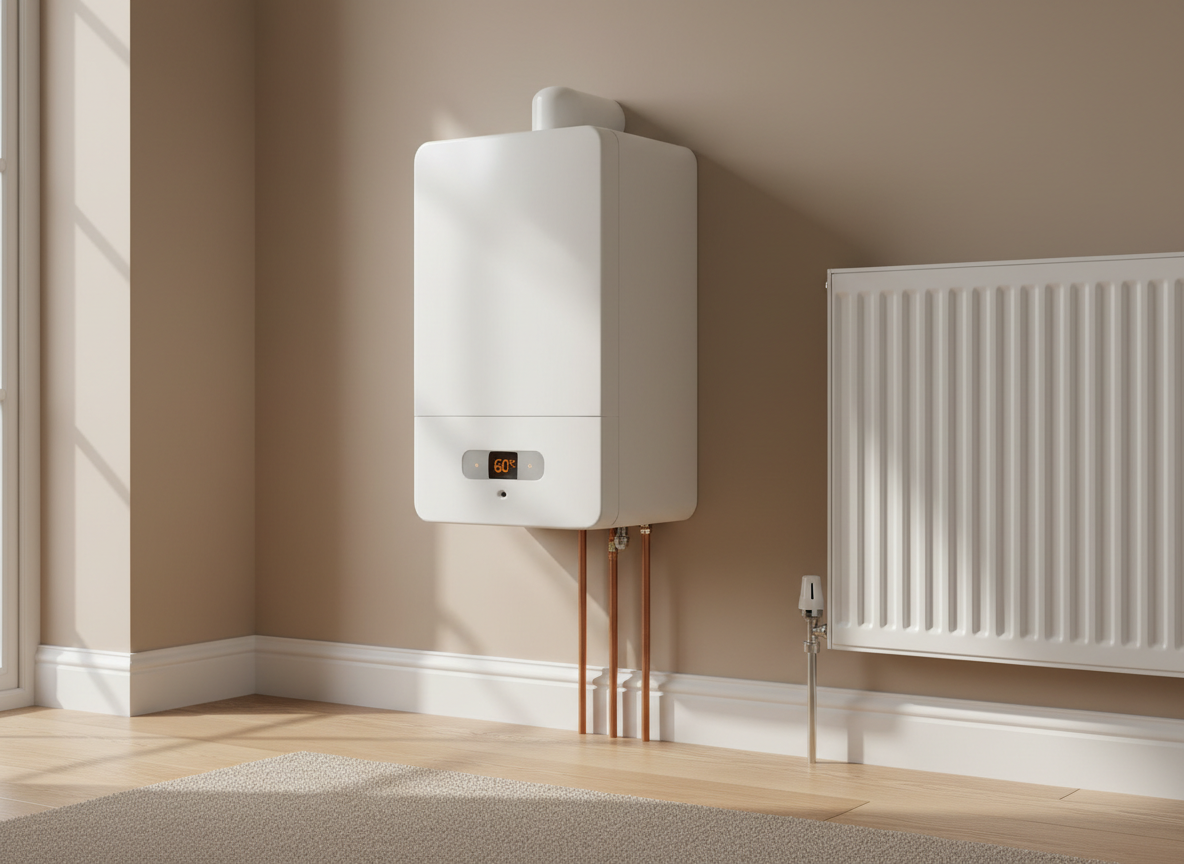
Your boiler could be heating your radiators to a much higher temperature than your home actually needs. Turning the heating flow temperature down is a simple, free adjustment that can help a modern condensing combi boiler run more efficiently.
For many UK homes with a condensing combi boiler and radiators, 60°C is a sensible place to start. If your home still heats comfortably, you may be able to experiment with a slightly lower setting.
What is boiler flow temperature?
Flow temperature is the temperature of the water leaving your boiler and travelling around your radiators. It is not the same thing as your room thermostat setting, and on a combi boiler it is separate from the temperature of the hot water coming from your taps.
Many condensing boilers have traditionally been set to around 70–80°C. That gives very hot radiators and can warm a house quickly, but it can stop a condensing boiler operating as efficiently as it could.
Why can a lower flow temperature save energy?
A condensing boiler is designed to recover heat from its exhaust gases instead of simply sending all of that heat outside through the flue. For that process to work effectively, the water returning to the boiler needs to be cool enough.
Nesta says condensation starts increasing when the return water is below roughly 54°C. Lowering the flow temperature generally lowers the return temperature too, allowing the boiler to spend more time operating efficiently in condensing mode.
Energy Saving Trust reports that reducing a boiler’s flow temperature to 60°C improved boiler efficiency by nearly 4% in Nesta research. Your actual gas saving will vary with your home, heating system, previous settings and how you use the heating.
So, what temperature should you try?
- Condensing combi boiler with radiators: try around 60°C as a starting point.
- Well-insulated home or milder weather: you may be able to try 55°C, then see whether every room still reaches a comfortable temperature.
- Underfloor heating: these systems are designed to work at lower temperatures; Citizens Advice suggests trying around 50°C, although the correct setting depends on the system.
- System or regular boiler with a hot-water cylinder: do not simply follow the combi-boiler advice below. Energy Saving Trust says the boiler thermostat should not be lowered below 65°C because doing so can increase the risk of Legionella bacteria growing in the cylinder.
There isn’t one perfect number for every house. The goal is to find the lowest practical flow temperature that can still heat your home comfortably when you need it.
How to turn down a combi boiler’s flow temperature
- Take a photo of your current settings so you can easily put them back.
- Find the central-heating/radiator temperature control on the boiler. Do not confuse it with the hot-water/tap control.
- Set the heating flow temperature to around 60°C.
- Use your heating normally and see how the house performs.
- If every room still heats comfortably, you can experiment by dropping it another 5°C.
- If rooms struggle to reach temperature, raise it again.
If you cannot identify the correct control, check the manual for your exact boiler rather than guessing. If your boiler uses weather compensation or another automatic flow-temperature control, speak to your installer before changing its settings.
Will my radiators feel cooler?
Probably — and that isn’t necessarily a problem. Lower-temperature radiators give out heat more gently for longer. Your house may take longer to warm up, but the boiler can operate more efficiently while getting it there.
If lowering the temperature means the house never reaches the temperature you’ve asked for, you’ve gone too low for the conditions. Older or undersized radiators and poorly insulated homes can also need higher flow temperatures, particularly during very cold weather.
Don’t confuse flow temperature with your thermostat
Setting your room thermostat to 20°C tells the heating how warm you want the room. Setting the boiler flow to 60°C controls how hot the water going through the radiators is. They do different jobs.
Take it a step further with smarter radiator control
Once your boiler is running sensibly, the next opportunity is controlling where that heat goes. Traditional thermostatic radiator valves (TRVs) let you reduce the temperature in individual rooms. Smart radiator valves take that idea further, allowing schedules and room-by-room temperature control from an app or smart-home system.
That can be particularly useful if, for example, you want the kitchen and living room warm in the evening without heating unused bedrooms to the same level.
Now live: our Best Smart Radiator Valves in the UK guide compares Hive, tado° X, Drayton Wiser, Aqara, SONOFF and Kasa, including which systems can actually request heat from the boiler.
The Switch & Sprout takeaway
If you have a modern condensing combi boiler, 60°C is a good starting point rather than a magic number. Try it, see whether your home still gets comfortably warm, and adjust from there. In milder weather or an efficient home you may be able to run lower; during a cold spell you may need to turn it back up.
A five-minute adjustment won’t transform an inefficient house, but getting the boiler, heating controls and radiators working together efficiently is exactly the sort of small improvement that can add up over a heating season.
Sources and further reading: Energy Saving Trust, Nesta and Citizens Advice. This guide is general information for UK households. Always follow the instructions for your specific boiler and heating system. If you’re unsure which setting controls your heating flow temperature, check the manufacturer’s manual or ask a qualified heating engineer.
Leave a Reply