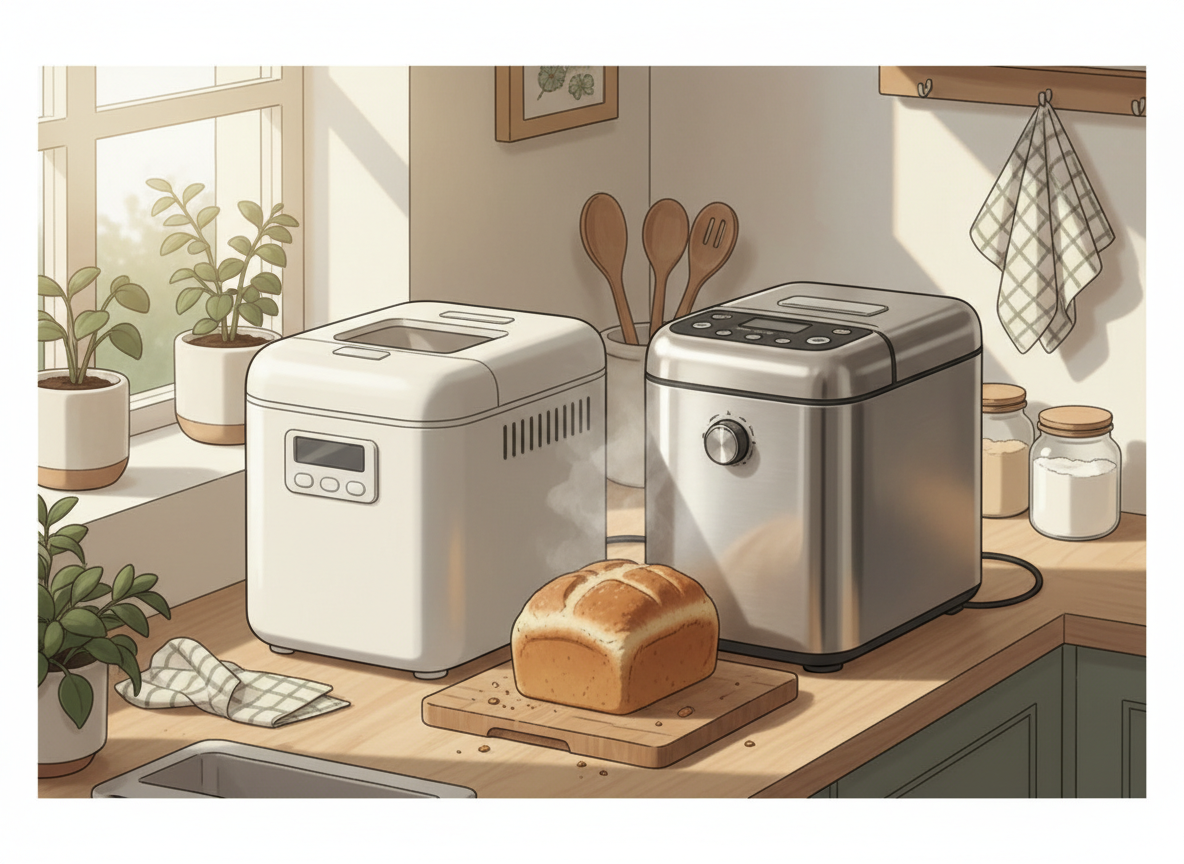
“Smart” bread maker sounds like it should mean Wi-Fi, an app and remote control. In practice, it often means something rather different. We compared a feature-heavy KITCHENARM 29-in-1 SMART Bread Maker with the much more conventional Morphy Richards Fastbake 48281 to see what you actually gain — and which type makes more sense for most kitchens.
Affiliate disclosure: this guide contains eBay affiliate links. If you buy through one of them, Switch & Sprout may earn a commission at no extra cost to you. Prices and availability can change.
First: what does “smart” actually mean here?
The biggest surprise is that the KITCHENARM is not being sold as a typical connected smart-home appliance. The manufacturer’s feature list focuses on 29 automatic menus, saved settings, customisable baking cycles and recipe flexibility rather than Wi-Fi or app control.
So in this comparison, “smart” really means more automation and more control inside the machine — not controlling your loaf from your phone.
KITCHENARM 29-in-1 vs Morphy Richards Fastbake at a glance
| Feature | KITCHENARM 29-in-1 SMART | Morphy Richards Fastbake 48281 |
|---|---|---|
| Programmes | 29 automatic menus | 12 programmes |
| Loaf sizes | 1 lb, 1.5 lb and 2 lb | 1.5 lb and 2 lb |
| Custom settings | Yes — programmable HOME MADE cycles and saved settings | Much simpler preset approach |
| Delay timer | Up to 15 hours | Up to 13 hours |
| Keep warm | Yes | Yes |
| Wi-Fi / app | No advertised app or Wi-Fi control | No |
| Best for | People who want to experiment and customise recipes | People who mainly want straightforward automatic bread making |
The “smart” choice: KITCHENARM 29-in-1
The KITCHENARM is the more interesting machine if you enjoy experimenting. Its 29 menus cover the usual basics plus options such as whole wheat, gluten-free, brioche, rye, cake, jam and yoghurt. The standout feature is the customisable HOME MADE programme, where individual knead, rest, rise and bake stages can be adjusted.
It can also remember settings for future bakes. That is the bit that earns the “smart” label more convincingly: once you have a recipe dialled in, the machine can make repeat bakes much less fiddly.
The straightforward choice: Morphy Richards Fastbake 48281
The Fastbake takes the opposite approach. It has 12 programmes, supports 1.5 lb and 2 lb loaves, includes a delay timer and keep-warm function, and is designed around choosing a programme and letting the machine get on with it.
For somebody who mostly wants white, wholemeal, French-style or similar everyday loaves without spending time programming individual stages, that simplicity may actually be the advantage.
So is the smart bread maker worth it?
If you want maximum flexibility, the KITCHENARM makes sense. The extra menus, saved settings and programmable cycles give you far more room to experiment with recipes and fine-tune how a loaf is made.
If you mainly want to put ingredients in a machine and get a loaf out, the Fastbake is probably the more sensible buy. More programmes are only useful if you are actually going to use them.
And that is the useful lesson here: don’t pay extra just because a bread maker says “smart” on the listing. Check what the smart features actually are. In this case they mean better automation and customisation — not another appliance demanding space on your Wi-Fi network.
Which would we choose?
For an enthusiast who wants to experiment with different flours, gluten-free recipes or custom rise and bake times, we would lean towards the KITCHENARM 29-in-1. For a first bread maker or an everyday appliance where simplicity matters more than tweaking every stage, we would choose the Morphy Richards Fastbake.
The right one depends less on the word “smart” and more on how much control you actually want.
Leave a Reply